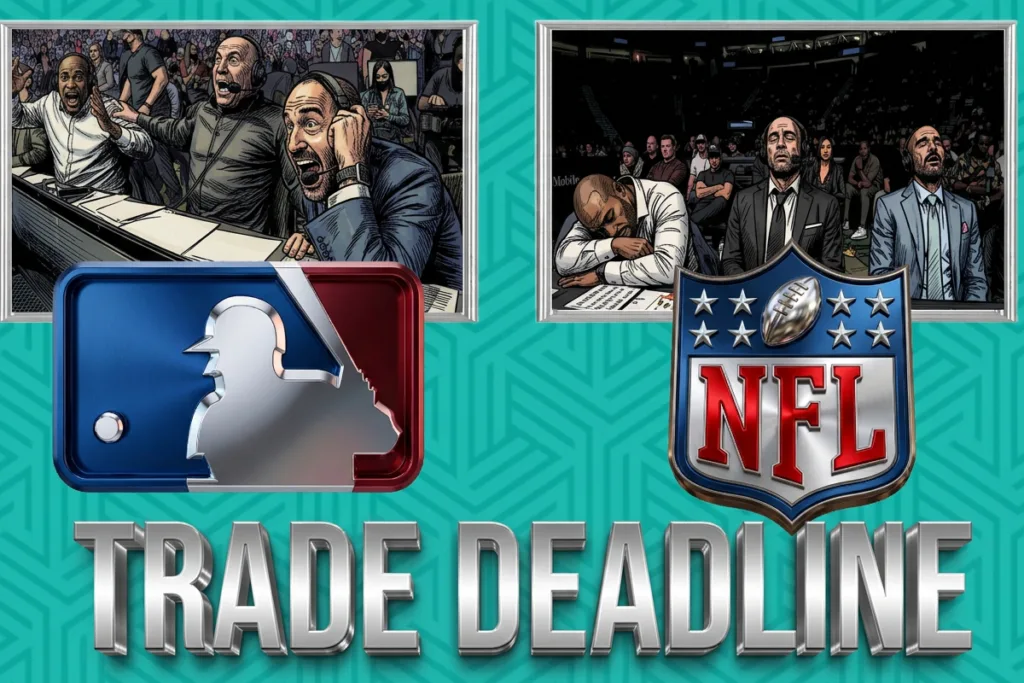
On their weekly Tuesday show, The Lights Out Sports Podcast, hosts Michael Ballentine and Cheez discuss the MLB trade deadline and what makes it so exciting. They posed and answered the question at the 16:15 mark of the show: How could the NFL trade deadline be more exciting, just like the baseball version? Cheez said it would be impossible and discussed the value of a minor league system, but the issues run deeper than that, and there could be a potential solution.
There are a number of problems that the NFL faces in trying to make the trade deadline more exciting. Four huge differences between the MLB and professional football that allow for excitement at one deadline but not the other. Here they are, in-depth, and the problems the NFL faces in adding some spice to its trade deadline.
NFL Trade Deadline Is Timed Poorly
In 2026, the NFL trade deadline is scheduled for Tuesday, November 10th. This marks the approximate halfway point of the NFL season. The MLB deadline of August third this year was about 67% of the way through the season. This makes much more sense, since anyone is still a contender (for the most part) at the midway point. In order for a trade deadline to be compelling, there have to be teams completely out of it, or sellers.
Nobody is selling a key piece of their team when they are 4-4, or even 3-5. The Carolina Panthers made the playoffs last year with a record of 8-9. The NFL needs to push back the deadline to let more teams completely fall out of the playoff picture. As long as 28 of 32 teams are still in the hunt, there wopn’t be any big trades to excite the fans.
NFL Contracts (And Trading Them) Are Too Complicated
In Major League Baseball, all of the contracts are fully guaranteed. Some of the money may be deferred to a later date (which they also discussed on the show), but all of it is guaranteed. When a team trades a player, the new team acquires the contract in full, and the old team is not on the hook for a dime. The trading team can send cash considerations, and that stays on their payroll, which is a smidge confusing, but if no cash is involved, 100% of the contract comes off the payroll.
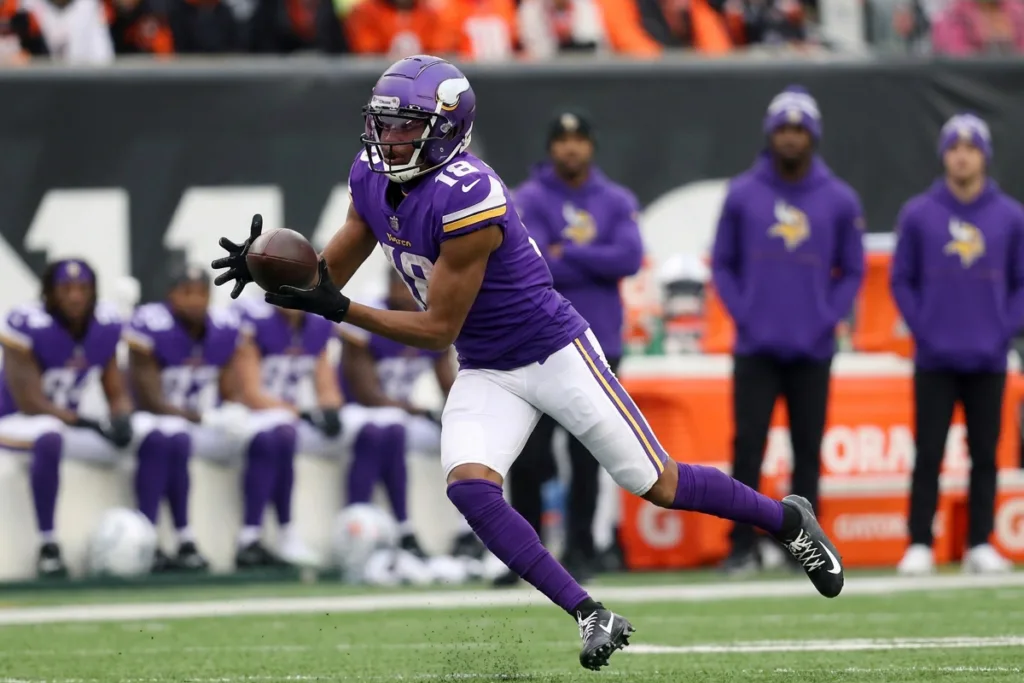
In the NFL, most contracts are only partially guaranteed, and if a team trades a player, they are still on the hook for the remaining guaranteed money in the deal, while the new team only counts the non-guaranteed portion against their cap (more on the cap later). For example, should the Minnesota Vikings trade Justin Jefferson, who has a four-year, $140 million contract with the team ($88.7 million guaranteed), they would incur a $49.3 million hit against their 2026 salary cap, which they could split into $24.65 million each of the next two seasons.
This makes trading players, particularly star players with huge contracts, difficult. The MLB doesn’t have to deal with that problem.
The MLB Has No Salary Cap
In baseball, if a team has a payroll north of $300 million, they can only afford to trade for the top 30 biggest salaries in the game at once. In other words, all teams are allowed to have a payroll of infinity. This makes trading players extremely easy. Every team in the league has the ability to acquire any player in the league, no matter their payroll, and no matter that player’s salary. They are the only sport of the Big Four that has that luxury (for now).
The NFL has a rigid salary cap and a salary floor. Teams are required to essentially all spend the same amount of money and save the same amount of money in order to create parity throughout the league. So, unlike baseball, if a team wanted to move a high-priced asset and was willing to eat the remaining guaranteed money in the deal, they could only trade that player to teams that have the cap space to absorb the contract. Only 13 teams could absorb Jefferson’s contract this year, and only five of them could afford his cap hit next year.
Having five potential trade partners, as opposed to 29, makes a huge difference at the deadline.
The NFL Has No Minor League System
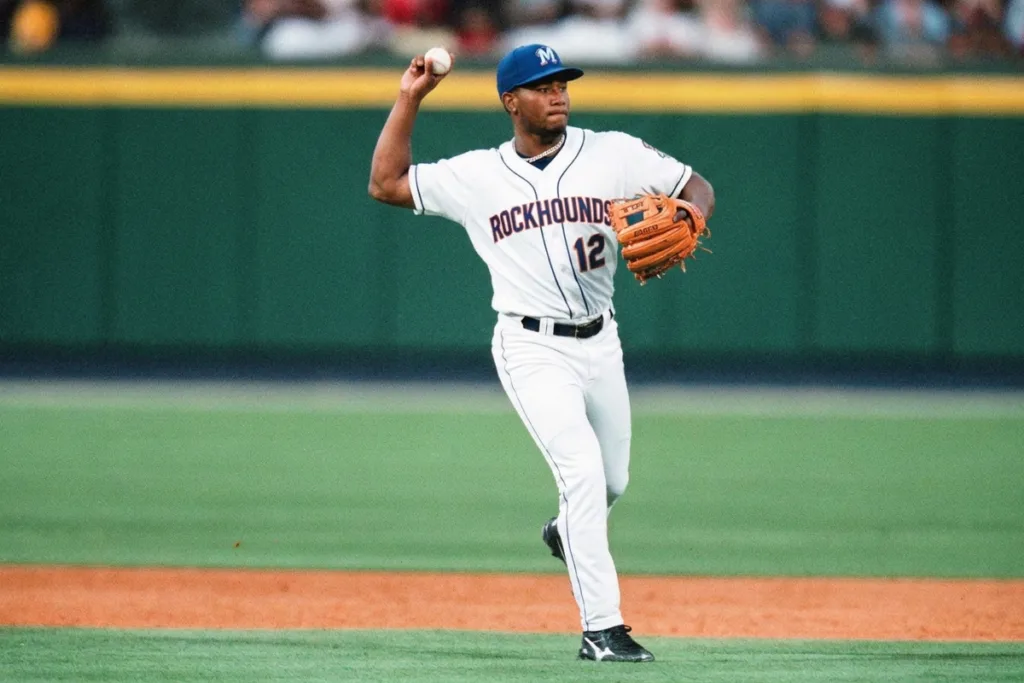
Technically, NCAA Football is the NFL’s farm system, but those players aren’t under any team’s control, so they can’t be traded. The benefit of trading minor league players for big league talent in baseball is that a team in contention can trade players who aren’t on the roster, helping them win, to acquire players who will be on the roster. It’s essential trading seeds for flowers that are in full bloom.
The NFL would have to trade roster players for roster players, so if they are in contention, they’d have to give up a piece of what made them in contention to get another piece. In other words, it’s a wash; the trade doesn’t make them any better. The acquiring team would have to trade draft picks for incoming players, which would affect the cap. Given the value of first-round picks, many of the deals at the deadline would be for 6th- or 7th-round picks, which does not add excitement.
Helping The NFL Be As Exciting As The MLB Trade Deadline
First and foremost, the trade deadline would have to be moved to December, after week 12 of the season. With five games left on the schedule, there would be a great idea of who is in and who is out of the playoffs, and more importantly, who is in the hunt. Next would be a salary waiver starting two weeks before the deadline. Basically, once the countdown hits 14 days, teams can trade the full contract of any player off their books onto another franchise. No cap hiot, no dead money.
As for the cap, it’s important that it not be tampered with too much, since it is the best economic system in all of sports. Teams must stay within the cap floor and ceiling at all times throughout the trade process, with the lone exception being a three-day grace period after a trade. During those three days, the team can renegotiate contracts, and should they choose to cut a player, the cap hit can be spread out over 4 years instead of two.
This would all have to be done in the 14-day window (technically 17 days to account for 3 days after the deadline). This way, teams can’t acquire a player on draft day and cut a subsequent player without penalty. If a team fails to get back under the cap within the three days, the player they acquired counts towards their roster, but is ineligible to play until they get back under.
If a team goes under the floor in a trade, they have the same 3-day window to get back above the floor, or every player on the roster gets a player option for a fully guaranteed year of their AAV (Average Annual Value) added to the end of their current contract with the team. It may seem harsh, but teams cannot be allowed to rig the system, which they will try to do.
This is the solution. It’s not perfect, but it is an idea to make the NFL trade deadline more exciting. In reality, it may be as Cheez said it was. Impossible.