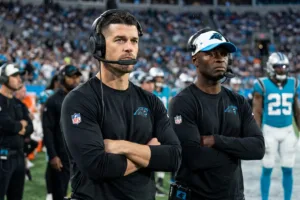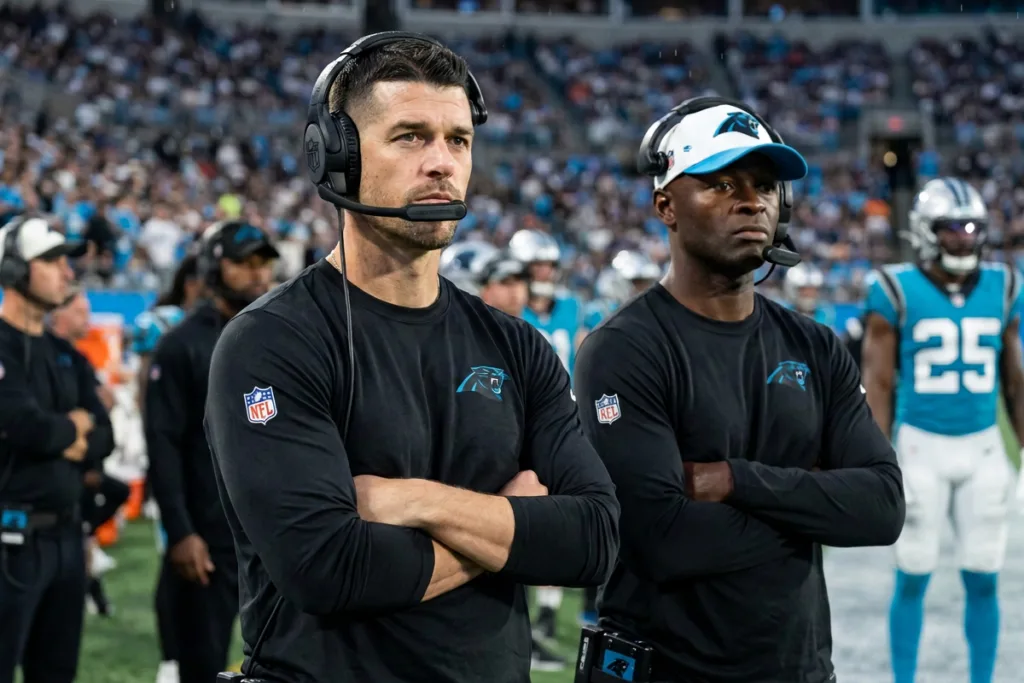
The immediate aftermath of Week 1 made one thing clear. The severe Carolina Panthers defensive struggles in Charlotte go far beyond the typical early-season rust. Week 1 is historically a trap for overreaction, and analytics departments across the league spend September begging media personnel and front offices to ignore early single-game variance. An exception must be made for the Panthers, because the result demands immediate evaluation.
The Chicago Bears’ 59-37 shellacking of Carolina is not an early-season fluke, but a structural indictment. When an NFL defense allows nearly 60 points at home on Opening Day, they are no longer discussing missed tackles or standard Week 1 miscommunications. What transpired was a complete system breakdown, and a performance that exposed every flawed assumption the Panthers’ front office made throughout their offseason build.
Root Causes Of The Carolina Panthers’ Defensive Struggles
For months, the narrative surrounding Charlotte focused on stability and systematic growth. The front office poured resources into offensive infrastructure, working to craft an environment where Bryce Young could process cleanly and operate within a rhythm. Against the Bears, that premise collapsed entirely. The Panthers entered Sunday hoping to prove their roster was capable of controlling the line of scrimmage and dictating pace. The Bears’ offense didn’t just win standard down-and-distance battles, but they tore through the Panthers’ defensive scheme with alarming ease.
The Bears created explosive plays at will, repeatedly attacking structural voids in Carolina’s secondary and overwhelming their interior front. When a defense surrenders scoring drives on nearly every execution cycle, it reveals two undeniable truths. The defensive roster lacks front-line, difference-making talent, or the schematic foundation offers zero margin for error when forced into script adjustments.
A Flawed Blueprint Under The Microscope

The most damning element of Sunday’s beatdown wasn’t just the final point total, but the absolute lack of pushback. Good teams weather early storms, adjust at halftime, and find ways to shrink scoring gaps. Carolina drifted into defensive anarchy as soon as Chicago pressed the tempo. By the third quarter, the Panthers were fundamentally incapable of setting the edge against the run or generating pressure without committing extra blitzers into coverage. Chicago’s play-callers identified the blueprint early and proceeded to turn the second half into an extended targeted drill.
This level of systemic failure forces an uncomfortable conversation about team building. Modern roster construction relies on synergy, which means keeping the offense on schedule to protect the defense, and a defense capable of manufacturing stops. When one side collapses this thoroughly, it drags the entire project into the mud.
Where Carolina Goes From Here
Games like this carry long-term consequences. They shatter locker room buy-in early and force management to rethink their entire multi-year timeline. After the game, Panthers All-Pro defensive lineman Derrick brown took full accountability as the undisputed leader of the defense. Chicago didn’t just earn a 1-0 start, but they served as a mirror for a Panthers franchise still lost in the wilderness. Unless Carolina confronts the fundamental roster gaps exposed in Week 1, 59 points won’t be an anomaly, but it will be the baseline for a very long season.
“