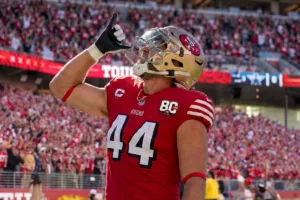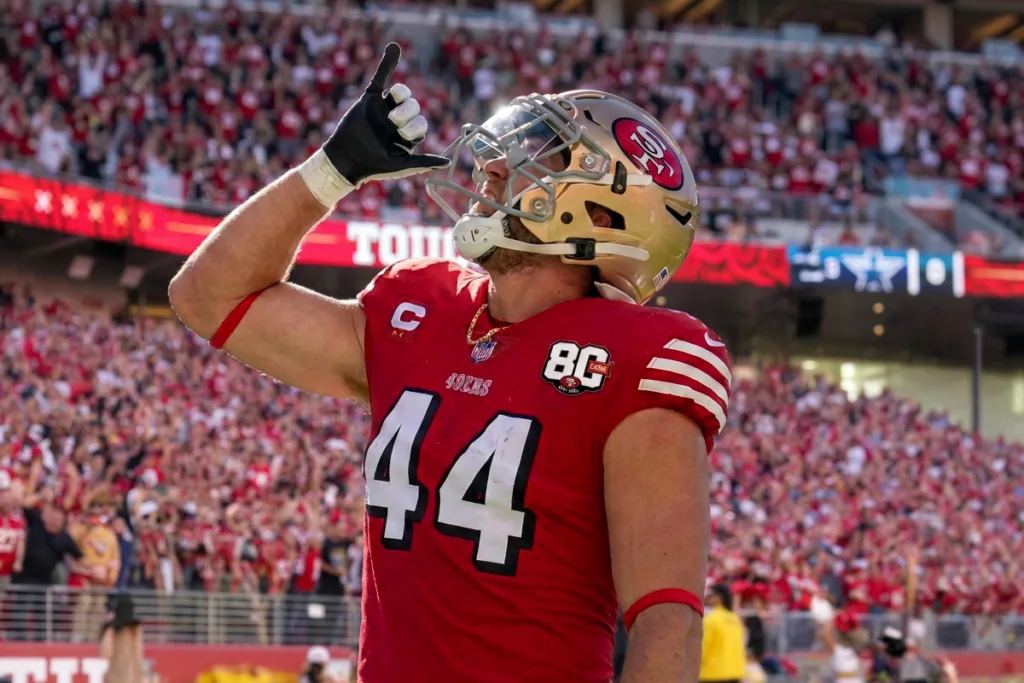
There were plenty of reasons for the San Francisco 49ers to celebrate in their game against the Miami Dolphins, as the team won handily with a final score of 35-13. One such celebration will cost nearly $15,000, as fullback Kyle Juszczyk’s fine was announced following the game. The Harvard alum was cited by the league for “engaging in offensive demonstrations” after scoring a touchdown and allegedly mimicking chugging a beer.
Juszczyk has denied this interpretation, stating that the imaginary beverage is actually juice, a nod to the nickname derived from his last name. He also noted that this is far from the first time he has used this gesture, explaining that it dates back years without any prior disciplinary measures. Juszczyk wasn’t the only player to receive this punishment; Indianapolis Colts offensive lineman Matt Goncalves also received a nearly $9,000 fine for a similar celebration.
Juszczyk has appealed his fine, and given his explanation as well as the vast public support he has received, the NFL has quite a decision to make in whether to uphold the penalty. The fullback did break the rule as written, particularly the clause that says the gesture has to be “reasonably construed as offensive”. There is an argument to be made, however, that anyone with knowledge of Juszczyk’s nickname could not reasonably construe the celebration in any other manner.
Why The Kyle Juszczyk Fine Is Hypocritical
The NFL fining players for mimicking beer drinking is hypocritical given the expansive relationship the NFL has with beer and the alcohol industry as a whole. Several beer ads air during every NFL game, and the beverage is sold at premium prices across every stadium. The NFL even has an official beer sponsor, Bud Light, which produces licensed cans featuring logos from nearly all 32 teams. Even in the NFL’s signature event, the Super Bowl, some of the most iconic and anticipated commercials every year are from Budweiser.
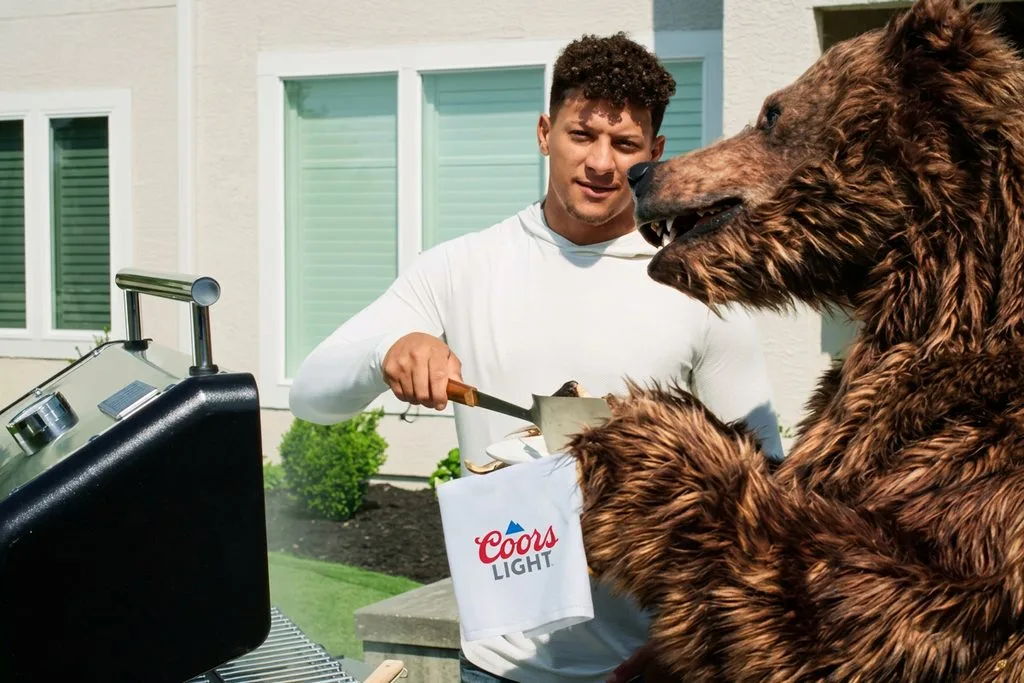
Current players are restricted from appearing in alcohol advertisements, but this rule has been subverted before, like when Patrick Mahomes appeared in a Coors Light ad. Former players can appear in whatever commercials they like, such as Peyton Manning for Bud Light. Some NFL players even partner with or own their own alcohol brands, like Travis Kelce and Dak Prescott.
For a league that seemingly has no problem displaying alcohol advertisements to the tune of hundreds of millions of dollars in profit, it seems unfair to hold players to a significantly higher standard. Why is it that when a player supposedly mimics drinking, it is deemed “offensive”, but countless ads endorsing drinking are perfectly acceptable? If the concern from the league is promoting drinking to children, inundating them with pro alcohol commercials seems much more harmful than a touchdown celebration. Especially if said touchdown celebration is, at best, debatably related to alcohol.
The “No Fun League”
Setting restrictions on celebrations is nothing new for the NFL, leading to its well-known reputation as the “No Fun League”. While banning gestures that are sexually explicit or mimic violence is one thing, fining players for doing things the league heavily endorses is hypocrisy at its finest.
A similar argument has been made in reference to gambling, but in this instance, there are no concerns over the integrity of the sport. Policing players’ involvement in betting is justifiable to ensure the legitimacy of the outcome of every game, even if the NFL heavily endorses gambling platforms. In the case of alcohol, there are no integrity concerns, suggesting the league is once again overstepping in its restrictions on celebrations.
The NFL has taken strides over the past several years in allowing players to do more with their celebrations, such as dances and coordinated team gestures. This is good for the game, as it adds to the fun and excitement of the sport. Fining players for “offensive” celebrations that didn’t even result in a penalty flag during the game is a step back in the wrong direction.