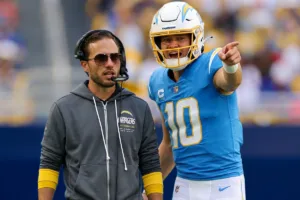
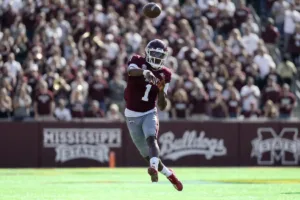
The Miami Dolphins’ 2026 NFL Draft was the capstone to an organization-wide rebuild over the offseason. In January, the team hired Jon-Eric Sullivan as general manager and Jeff Hafley as head coach to replace Chris Grier and Mike McDaniel. The Dolphins also parted ways with many key players from the Grier–McDaniel era, including Tua Tagovailoa, Tyreek Hill, Jaylen Waddle, and Bradley Chubb.
Miami added 13 players in the draft, including two in the first round and six in the top 100. Their biggest priorities were to bolster their lackluster defense and surround new quarterback Malik Willis with enough talent to succeed.
With holes all over the roster, Sullivan and Hafley took seven offensive players and six defenders, emphasizing positional value over needs. The new administration also made a clear effort to add size and physicality to the roster, after years of the Dolphins being viewed as a “soft” team.
Both coming from the Green Bay Packers, Sullivan and Hafley know how to build and prepare teams for playoff football and January weather. This draft was all about transforming the Phins’ identity and setting the team up for long-term success in a competitive AFC East. But did they pull it off?
Here are the picks and grades for the 13 selections the Dolphins made in the 2026 NFL Draft.
Round 1, Pick 12: Kadyn Proctor, Offensive Tackle, Alabama

The first selection of an administration usually tells you a lot about the new leadership’s roster-building philosophy, and this was no exception. The Dolphins took Alabama’s enormous left tackle Kadyn Proctor with the 12th-overall pick, making him the third offensive lineman off the board.
While Proctor is a perfect culture fit, he was a reach at 12 based on his NFL projection. The oversized, heavy-footed tackle has undeniable power, but he’ll struggle to stay in front of NFL-caliber speed rushers.
To make matters worse, the Dolphins traded down one spot with the Cowboys, who took Ohio State safety Caleb Downs—the second-best overall player in the class. In return, Miami received two extra picks in Round 5, which is not nearly enough to justify passing on a player like Downs.
The Dolphins have announced a plan to start Proctor at guard in year one. This only makes the selection more baffling, however, since a far better guard was still available in Olaivavega Ioane. Essentially, Miami drafted a decent offensive lineman but didn’t get the best player, the best tackle, or the best guard available with their selection.
Grade: C-
Round 1, Pick 27: Chris Johnson, Cornerback, San Diego State

Cornerback was a big need for the Dolphins, although their ramshackle group led by Rasul Douglas and Jack Jones held up surprisingly well in 2025. Given Douglas’s age (31) and Jones’s spotty track record, Miami was eager to add to their CB room.
Chris Johnson out of San Diego State was the Dolphins’ second pick in the first round. Johnson is a well-rounded prospect, with good size (6’0”, 193 pounds), speed (4.4 40-yard dash time), and coverage skills in both man and zone. He was somewhere between CB #4 and CB #6 on most draft boards, so taking him as the second CB was a bit of a reach.
Unlike the Proctor pick, however, the Dolphins didn’t pass on a generational prospect this time around (depending on how you feel about Jermod McCoy’s knee). Johnson is a solid player who will make an instant impact for the new-look Dolphins.
Grade: B
Round 2, Pick 43: Jacob Rodriguez, Linebacker, Texas Tech

Jacob Rodriguez was a three-star quarterback before transitioning to the other side of the ball. As a linebacker, Texas Tech’s defensive captain led the Red Raiders to the Quarterfinals of the College Football Playoff. Throughout his collegiate career, Rodriguez demonstrated leadership and a nose for the football (with 11 forced turnovers in 2025).
He doesn’t have prototypical measurables (6’1”, 231 pounds), and his sideline-to-sideline speed is better than advertised but still not elite. What he does have, however, is ideal intangibles and an unteachable football IQ. He’s a fierce run stopper and a ballhawk who consistently puts himself in position to make plays on the ball.
With the 43rd pick, the Dolphins added a defensive starter, a culture changer, and most likely a future team captain.
Grade: A
Round 3, Pick 75: Caleb Douglas, Wide Receiver, Texas Tech

Following the widely celebrated Rodriguez pick, the Dolphins shocked the world by taking Caleb Douglas, ESPN’s 191st-ranked prospect, in the third round. It was a mystifying choice—especially since Miami had two picks later in the round (plus five total picks in rounds 4 and 5). It’s safe to assume that Miami could have waited and taken Douglas with pick 94 (if not 180), but clearly they didn’t think so.
At 6’3”, 206 pounds, Douglas has impressive measurables, but his college tape was lackluster. Despite running a 4.39 40-yard dash at the Combine, the Texas Tech product isn’t a deep threat. He also struggles to win contested catches, is plagued by concentration drops, and isn’t an asset as a run blocker.
The Dolphins’ WR room is so depleted that Douglas will probably get a lot of playing time in year one, but that doesn’t necessarily mean he’s a starting-caliber receiver.
Grade: D-
Round 3, Pick 87: Will Kacmarek, Tight End, Ohio State

Will Kacmarek is a pure, old-school blocking tight end. The Dolphins could have picked up the Ohio State tight end (or someone with a comparable skillset) later in the draft, but he’s a perfect fit for their new offense. Kacmarek is a powerful run blocker with strength to anchor or move defenders at the point of attack. He has limited upside as a receiver, but there’s some untapped potential in his game.
While this was far from a mid-round steal, teams get a bit of a pass on drafting to fill needs in a class as weak as this one. Kacmarek is a useful player who will excel immediately in his role as a complement to Greg Dulcich. He’ll play meaningful snaps in a talent-starved offense, which is a solid use of a third round pick—even if it’s not the most exciting selection.
Grade: C
Round 3, Pick 94: Chris Bell, Wide Receiver, Louisville

With their third pick of the round, the Dolphins selected another receiver—this time getting much better value on a considerably better player. Before the draft, some mock drafts had Louisville’s Chris Bell going as early as the first round. Instead, the 6’2”, 222-pound pass catcher fell into Miami’s lap at 94, in large part due to an ACL tear in his final year of college.
Bell is a powerful receiver with enough long speed to create plays down the field and plenty of strength to break tackles and run after the catch. He isn’t an advanced route runner, but he has strong, reliable hands. Even if it takes him some time to rehab his knee injury, he’ll most likely be the Dolphins’ number one receiver by the end of the 2026 season.
Grade: A-
Round 4, Pick 130: Trey Moore, Edge, Texas

Trey Moore was productive in college as a pass rusher and off-ball linebacker, but he doesn’t have the body type or athleticism to play either role full-time in the NFL. He’s a step slow for three-down linebacker duties, and he doesn’t have the size (sub-6’2”, sub-32” arms) to hold up on the edge.
The former Longhorn projects as a versatile third linebacker in base personnel, with upside as a pass rusher in odd fronts and NASCAR packages. Moore is a chess piece, and his success in the NFL depends heavily on his usage in Jeff Hafley’s new defense.
Grade: C
Round 4, Pick 138: Kyle Louis, Linebacker, Pittsburgh

The Dolphins’ class was a rollercoaster of tremendous value picks and outrageous reaches. Their selection of Kyle Louis with the third-to-last pick of the fourth round was resoundingly the former. The 2024 first-team All-American played the “Star” role at Pittsburgh, a position that combines outside linebacker, safety, and nickel cornerback duties. Louis excelled at every aspect of his role, thanks to his excellent play recognition and athleticism.
Against the run, Louis is an opportunistic penetrator, not a gap filler. He’s extremely undersized (6’0”, 220), which severely limits his ability to play OLB in the NFL. He’s expected to play more as a box safety/big nickel for the Dolphins, where he can showcase his coverage abilities and create havoc as a blitzer. This was one of the best picks of the entire draft.
Grade: A+
Round 5, Pick 158: Michael Taaffe, Safety, Texas
Another Texas defender, Michael Taaffe profiles as a career backup at the safety position. Although he lacks deep-field range, Taaffe is a true free safety who excels in coverage and has good instincts for the position.
His experience (36 college starts) and stellar processing mask some of his size (6’0”, 190 pounds) and athletic limitations. That said, he’s not a plus defender when he has to step into the box and make tackles against physical running backs. Taaffe will be a useful depth player with spot start potential, and he’ll likely have a chance to improve his tackling as a core special teamer to start his career.
Grade: C
Round 5, Pick 177: Kevin Coleman Jr., Wide Receiver, Missouri
The Dolphins invested a lot of money into Malik Willis in free agency, and they doubled down on that investment by adding three wide receivers in the draft. Kevin Coleman Jr. is a slot receiver whose playstyle is the perfect complement to the bigger-bodied Caleb Douglas and Chris Bell.
Coleman is a natural separator who creates easy completions underneath and can win down the field, despite his lack of size (5’10”, 179 pounds). The Missouri wideout has reliable hands and a surprising amount of juice as a ball carrier—which he showcased as a punt returner in college. Even as a fifth-round rookie, he’s a safe bet to lead Miami in receptions in 2026.
Grade: A
Round 5, Pick 180: Seydou Traore, Tight End, Mississippi State
At pick 180, the Dolphins added yet another pass catcher to their revamped offense. Seydou Traore is a developmental project at this stage in his career who is almost the exact opposite of third-round rookie Will Kacmarek. Traore is small (6’3”, 233 pounds) but fast, and he has impressive hands, which gives him upside as an F tight end or power slot.
He doesn’t bring much to the table as a blocker, and his route running needs a lot of work, but he makes sense as a high-ceiling backup for the oft-injured Greg Dulcich.
Grade: C
Round 6, Pick 200: DJ Campbell, Guard, Texas

At this point in the draft, teams are just looking for someone who can compete for a roster spot, and DJ Campbell is exactly that. Although he doesn’t have ideal mass for an offensive lineman (6’3”, 313 pounds), Campbell has long arms (34”) and solid technique.
Despite extensive experience at Texas, his potential as an NFL starter is limited by his stiffness as a pass protector and slow feet. Campbell won’t move the needle for the offense, but he will almost assuredly make the active roster and maybe even start a few games as a rookie.
Grade: B
Round 7, Pick 238: Max Llewellyn, Edge Rusher, Iowa
Max Llewellyn doesn’t have the length (32” arms), strength, or explosiveness to reliably beat NFL tackles. He doesn’t always play with good leverage as a run defender, although he compensates somewhat with frequent tackles for loss as a gap penetrator.
As a pass rusher, Llewellyn wins with technique and finesse—which may not translate to the next level, where most blockers are stronger, longer, and more technically sound. He’s more likely to be a career backup or wash out of the league entirely than he is to become a full-time starter. That said, his production against elite competition in the Big Ten makes his unconventional style worth a dart throw in the seventh round, even if he’s difficult to project.
Grade: C-
Undrafted Free Agent Additions
- Mark Gronowski, Quarterback, Iowa
- Le’Veon Moss, Running Back, Texas A&M
- Anthony Hankerson, Running Back, Oregon State
- Donaven McCulley, Wide Receiver, Michigan
- Kevin Cline, Offensive Tackle, Boston College
- Jim Bonifas, Center, Iowa State
- Rene Konga, Defensive Tackle, Louisville
- Mason Reiger, Edge, Wisconsin
- Rodney McGrawy, Edge, Western Michigan
- Louis Moore, Safety, Indiana
Final Miami Dolphins 2026 NFL Draft Grade: B
Best Selection: Kyle Louis
Worst Selection: Caleb Douglas
For the most part, the Dolphins took a quantity over quality approach to the 2026 Draft. This class could have been an A or A+ if they had reached on fewer picks, but they still found some value in later rounds and acquired a number of players who will get significant playing time as rookies.
The Dolphins didn’t raise the ceiling of their roster as much as they could have, but with 13 new players added over the weekend, they absolutely raised the floor. They also get bonus points for the sheer amount of incoming talent through both the draft and their UDFA class. Miami’s long-term outlook now depends largely on the next 12 months—and especially on the development of Malik Willis.