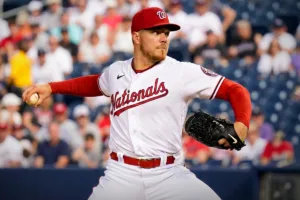
Dylan Crews has quietly become a key contributor to the Washington Nationals’ return to relevance. The word that contrasts Crews’ most recent call-up with his original debut is “quiet”. After debuting late in 2024 and entering 2025 with enormous expectations, Crews now appears to be settling into a more sustainable version of himself in 2026.
This was bound to happen with Crews ever since he was drafted second overall in 2023. From Scott Boras-directed media conferences onward, Nats fans believed they had landed the true prize of the 2023 draft. With Pittsburgh having selected Crews’ LSU teammate, pitching sensation Paul Skenes, with the top pick, Nationals faithful relished in their convictions that they had their guy.
Now, in 2026, Crews has again cracked the Nats’ starting lineup but with far less hype and fanfare than might have been associated with his high-profile debut. He quickly showed that his power projections were accurate, hitting three impressive bombs in his first 31 games with the big club.
Crews’ Plate Discipline
Crews’ plate discipline, though, and ability to get on base, two hallmarks of his record-setting career at LSU, appeared to abandon him altogether. He struggled mightily in Spring Training, and despite having a starting position in the Nats outfield all but guaranteed entering 2025, Crews left West Palm Beach with stats that didn’t instill full confidence in his place in the lineup.
An oblique strain can partially be attributed to Crews’ limited action in 2025. His production, though, essentially mirrored what his output was in ‘24, but with a slightly larger sample size. Crews’ approach, whether it was swinging for the fences or just trying too hard, just was not working.
This obviously isn’t the first time a can’t-miss, highly touted prospect has required fine-tuning to make an adjustment that would allow for success at the big league level.
Baseball history is filled with elite prospects who needed time before their talent fully translated at the major league level.