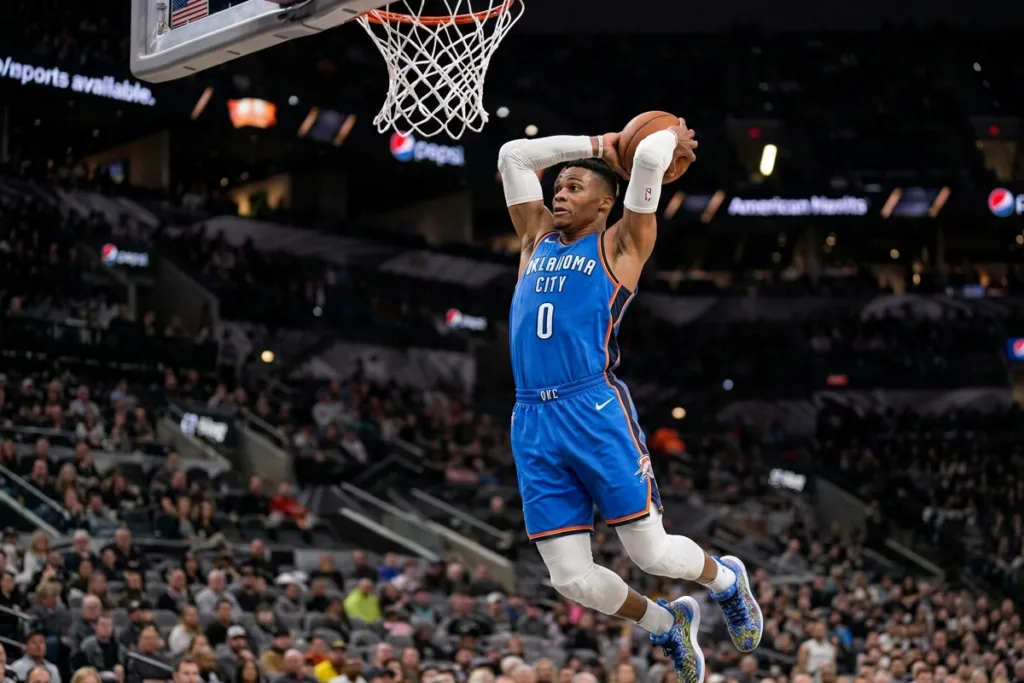
When evaluating the greatest all-time point guards in NBA history, few players evoke as much passion and debate as Russell Westbrook. With his official retirement capping off an extraordinary 18-year NBA career, Westbrook leaves behind one of the most explosive, captivating, and fiercely debated legacies in modern sports history. From the moment he entered the league, he redefined what was physically possible at the point guard position.
Combining track-and-field athleticism with an unrelenting competitive motor, Westbrook played every single possession like it was his last. Beyond the viral highlights and ferocious rim-rattling dunks, he built a historical resume that cements him among the absolute titans of basketball history. Analysts and historians generally place him in the elite second tier, landing comfortably between the sixth and tenth spots overall.
Russell Westbrook: Resume And Historical Statistical Profile
To understand Westbrook’s place in history, one must first appreciate the sheer magnitude of his achievements. Over nearly two decades, he collected a cabinet of honors that very few players in league history can match. He was named 2016-17 NBA Most Valuable Player, earned nine All-NBA team selections, selected to nine All-Star games, and was honored as a member of the NBA 75th Anniversary Team. He also claimed two scoring titles and led the league in assists three separate times, proving his ability to influence games as both a premier scorer and an elite facilitator.
Beyond individual accolades, Westbrook’s long-term production ranks among the most durable and prolific in NBA history. He ended his career with 27,176 points (14th all-time), 10,351 assists (5th), and 2,038 steals.
Most famously, Westbrook became the undisputed king of the triple-double, retiring as the all-time leader with 199 for his career. Before Westbrook, Oscar Robertson’s 1961-62 season-long triple-double was widely viewed as an untouchable relic of an ancient era. Westbrook not only matched that feat during his historic 2016-17 MVP campaign, but he averaged a triple-double across four full seasons, cementing his place as a statistical pioneer.
Assessing The All-Time Point Guard Hierarchy

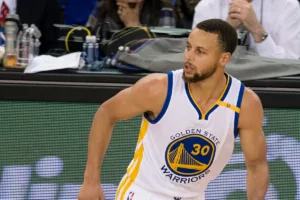
When ranking point guards across eras, analysts generally group the greatest floor generals into distinct tiers based on peak dominance, overall longevity, and team success. The undeniable top tier belongs to Magic Johnson and Stephen Curry, two iconic superstars who served as the engine for multiple championship dynasties while fundamentally changing how the game of basketball was played.
The prestigious tier below them features legends like Oscar Robertson, Isiah Thomas, Chris Paul, John Stockton, Steve Nash, and Jason Kidd. Those players either captured rings as primary stars or maintained unmatched efficiency and elite playmaking for well over a decade.
Westbrook firmly anchors the next wave of all-time greats. While Nash and Kidd offer traditional pass-first mastery or higher scoring efficiency, Westbrook’s sheer statistical volume and individual peak lift him into the same conversation. In most consensus lists compiled by major sports outlets and basketball historians, Westbrook naturally settles into the range between #6 and #8 overall, often hovering right next to Paul and Nash.
His Case As A Top Point Guard All-Time
The primary argument for placing Westbrook in the top five rests on his astonishing peak dominance and unyielding consistency. His 2016-17 MVP season remains one of the most impressive solo performances in basketball history, as he carried the Oklahoma City Thunder on his back while averaging 31.6 points, 10.7 rebounds, and 10.4 assists per game. His relentless energy allowed him to impact every phase of the game, particularly on the boards, where his 6’3″ frame regularly out-rebounded opposing centers to kickstart fast breaks.
Westbrook’s durability during his prime was remarkable. In an era increasingly defined by load management, Westbrook approached the regular season with fanatical intensity, rarely missing games and maintaining a high level of performance night after night. His ability to rank in the top five all-time in assists while simultaneously acting as one of his generation’s top scorers underscores a rare versatility that few point guards have ever possessed.
Historical Caveats & Playoff Limitations
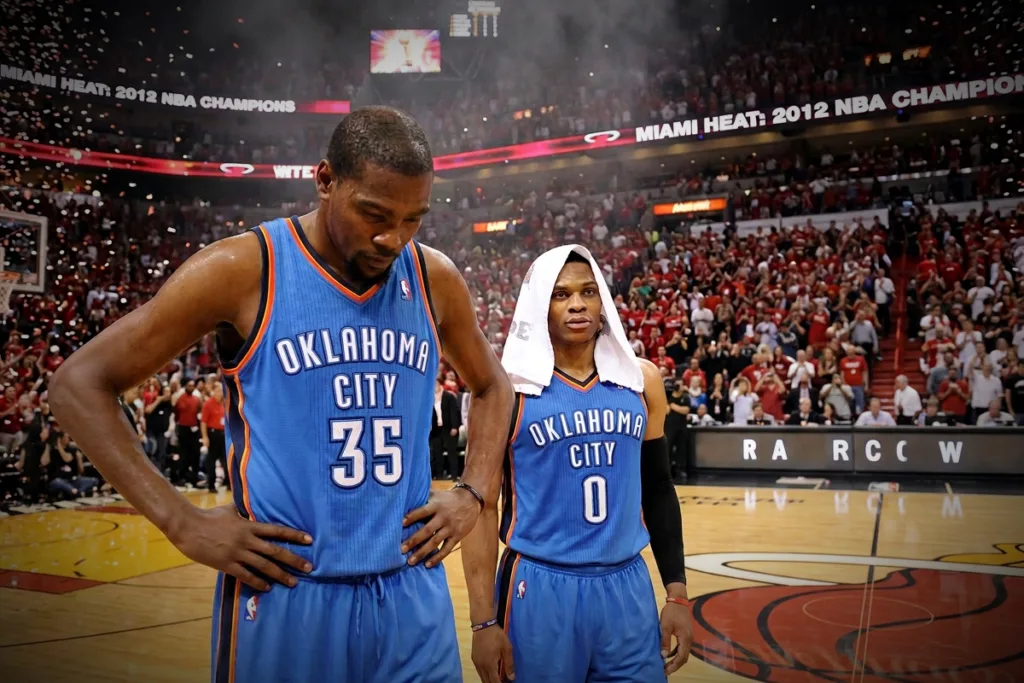
Despite his immense strengths, the arguments that keep Westbrook outside the universal top five center on championship pedigree, efficiency, and postseason outcome. Unlike Magic, Curry, or Thomas, Westbrook was never able to capture an NBA championship as the primary leader or the focal point of a franchise. His closest opportunity came in 2012 when the young Thunder reached the Finals.
Critics also point to his hyper-aggressive playstyle, which often produced low shooting percentages from behind the arc and outside the paint, alongside high turnover numbers resulting from his heavy usage rates. Following Kevin Durant’s departure from Oklahoma City, Westbrook’s teams frequently experienced early playoff exits, which cooled some of the momentum generated by his regular season brilliance. For purists who prioritize championship rings and high-efficiency orchestrators, these factors place a natural ceiling on where he could be ranked.
Final Verdict: An Unshakable Legacy
Westbrook’s career cannot be measured solely by what he lacked, but rather by the unprecedented fireworks he brought to the court every night. He broke statistical records that had stood for half a century and maintained an intensity that made him one of the most entertaining and fearsome competitors of his generation. While he may lack the championship hardware of the top five point guards in history, his MVP trophy, statistical supremacy, and sustained excellence guarantee him a spot among the top ten point guards to ever play the game. He sits comfortably settling around seventh and eighth all-time as an absolute lock for a first-ballot Hall of Fame induction.