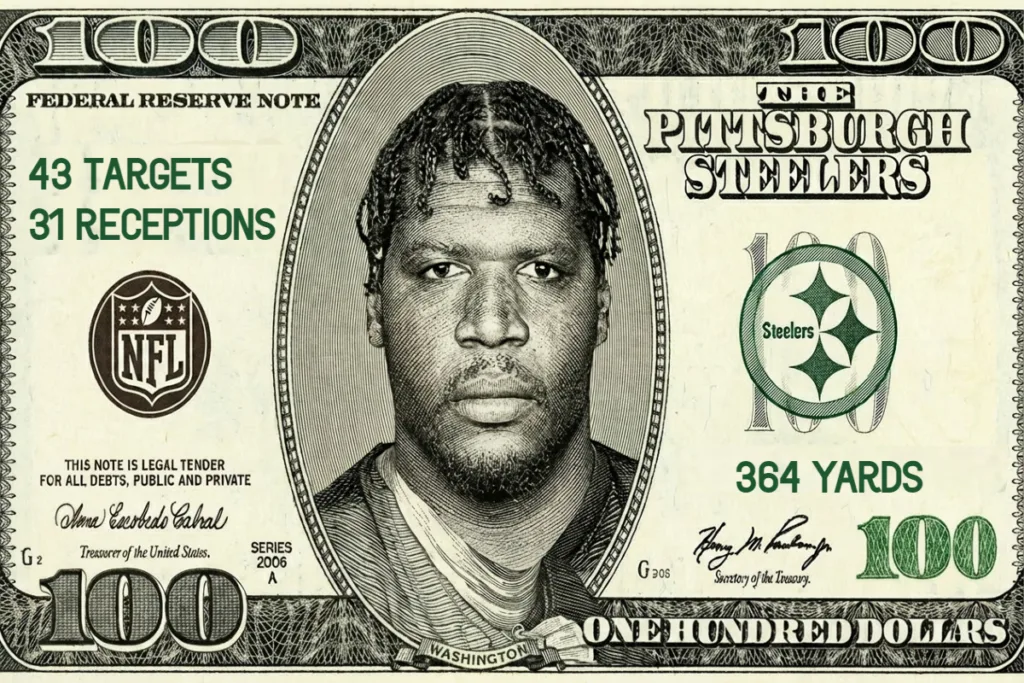
The Pittsburgh Steelers’ Darnell Washington extension has been finalized, and it’s for four years and $42 million. To call the timing and amount of the deal puzzling would be an understatement. Washington did have career numbers last season for the Steelers, but it hasn’t been a shining career. He was targeted 43 times, hauling in 31 receptions for 364 yards and a touchdown.
It isn’t like Washington’s numbers were affected by an injury. He played in 16 games last year. Over his first three seasons, he has only missed one game (50 games played), yet he’s only managed 57 career receptions. It’s hard to remember a time in league history when a player who averaged one reception per game was rewarded for that effort with eight figures per year. His AAV of $10.5 million per year ranks 11th in the NFL, just behind Evan Engram of the Denver Broncos.
Washington is now making more than T.J. Hockenson of the Minnesota Vikings, who last season caught 51 balls for 438 yards and three touchdowns. Over the last three seasons, Hockenson has averaged 62 receptions for 620 yards per game. How does a player like Washington make more than a player who has produced at double the rate? It could be argued that Washington is making less than Cole Kmet, who had 28 receptions for 243 yards last season.
While this is true, it’s more of a half-truth, because Kmet was awarded his contract after the 2025 season, when he recorded47 receptions for 474 yards, and had a three-year average leading up to the extension of 57 receptions for 580 yards. Even that may not warrant his $12.5 million per year deal, but his production was still double that of Washington’s.
Tight End Is Low In Value
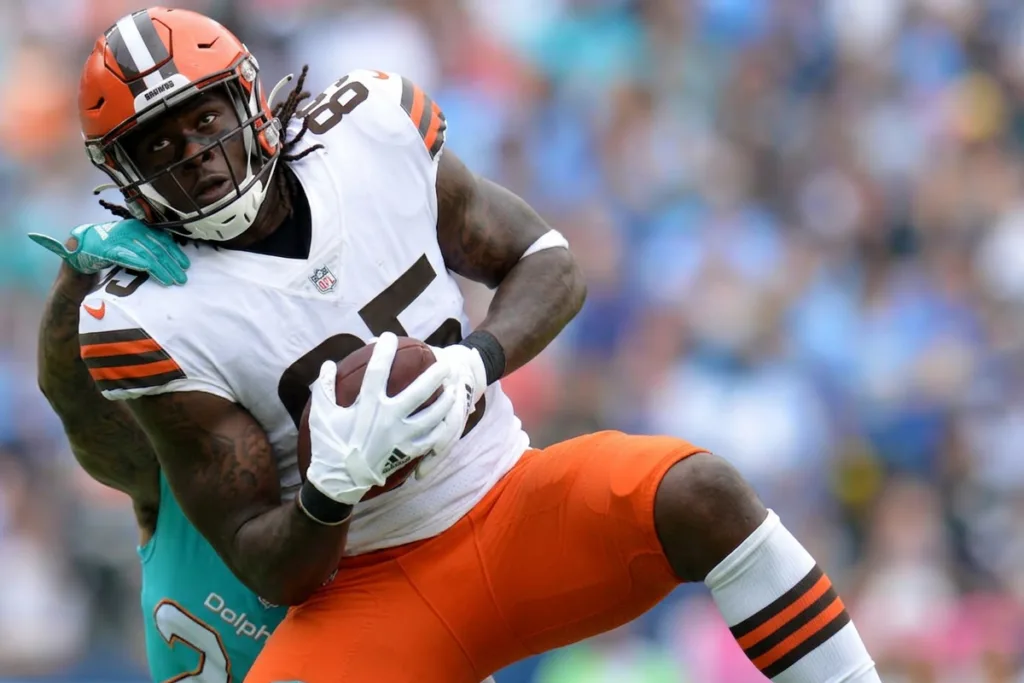
The extension also makes no sense because the position of tight end isn’t the most valuable. In terms of replacement cost by position, Tight End ranks about the same as interior offensive lineman, and just ahead of running back, kicker, and punter. It doesn’t make sense to give a player like Washington more than $10 million when a free agent like David Njoku would take half of that.
Njoku had total numbers similar to Washington’s last year (33 receptions for 293 yards), but he only played 12 games. The year before, he played 11 and doubled Washington’s production. Going into his 30-year-old season, $5 million a year for him seems like a much better deal. If the Steelers value youth at the position over performance, they could have looked to the draft.
Pittsburgh could have replaced Washington’s rookie deal with a new rookie deal and saved some money as well. They may not have had a shot at this year’s top tight end, Oregon’s Kenyon Saddiq, but they could have gotten Eli Stowers out of Vanderbilt (Round 2, pick 22) or Ohio State’s Max Klare (Round 2, pick 29). Both players went after the Steelers selected Germie Bernard out of Alabama, and would have cost the team just $2.7 million per year. They didn’t need a receiver that high, with DK Metcalf and Michael Pittman already on the roster.
Kyle Pitts, who was just franchise-tagged by the Atlanta Falcons, had 88 receptions last season. The tag for tight end is just $15 million, so the Falcons are paying 50% more to Pitts than the Steelers are to Washington, but it’s based on nearly triple the production.
Was The Darnell Washington Extension A Cap Move?
NFL teams are required to spend a salary floor, and sometimes they will pay players more than they deserve to hit the minimum threshold. This is not the case with the Steelers, though, because they only have $4.3 million in cap space and $40 million next season.
According to Pro Football Focus (PFF), Washington was ranked 35th out of 37 eligible tight ends in targets, 35th in receptions, and 33rd in touchdowns. Hardly seems like it makes sense to give him a top-10 salary. Maybe that just happens to be the going rate for below-average tight ends, though. After all, Isaiah Likely just got a three-year, $40 million contract ($13.3 million AAV) from the New York Giants after catching 27 balls for 307 yards.
The entire thing is perplexing, and if anyone believes in conspiracy theories, maybe this was a demand by the senior citizen coming back to play quarterback next year. Even that makes no sense, however, because why would a team give a multi-year deal to a player to appease someone who will only be there for one year? The reasoning may never be revealed, but it doesn’t matter. Whatever the thought process was behind the extension, it was a bad move.